How to Mount and Display Art Works on Paper

At the art dealer by Max Gaisser, 1889
An art dealer is a person or company that buys and sells works of art, or acts equally the intermediary between the buyers and sellers of art.
An art dealer in contemporary art typically seeks out various artists to stand for, and builds relationships with collectors and museums whose interests are likely to match the piece of work of the represented artists. Some dealers are able to anticipate marketplace trends, while some prominent dealers may be able to influence the gustation of the market. Many dealers specialize in a particular style, menstruation, or region. They often travel internationally, frequenting exhibitions, auctions, and artists' studios looking for skillful buys, little-known treasures, and exciting new works. When dealers buy works of fine art, they resell them either in their galleries or directly to collectors. Those who deal in gimmicky art in particular commonly exhibit artists' works in their own galleries. They volition often take part in preparing the works of fine art to be revealed or candy.[i] [2] [3]
Art dealers' professional associations serve to set high standards for accreditation or membership and to back up fine art exhibitions and shows.[4]
History [edit]
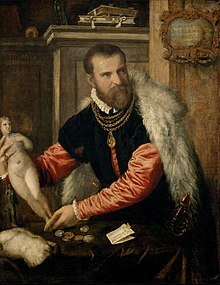
The art dealer as a singled-out profession perhaps emerged in the Italian Renaissance, in particular to feed the new appetite among collectors for classical antiquities, including coins. The somewhat disreputable grapheme of Jacopo Strada is oftentimes said to be reflected in his portrait past Titian (1567).
Job requirements [edit]

Art dealers often report the history of art earlier entering on their careers. Related careers that ofttimes cross-over include curators of museums and art auction firms are manufacture-related careers.[four] Gallery owners who do non succeed may seek to work for more than successful galleries. Others pursue careers as art critics, academics, curators of museums or sale houses, or practicing artists.[5]
Dealers have to empathize the business organisation side of the art earth. They keep up with trends in the market place and are knowledgeable about the way of art people want to buy. They figure out how much they should pay for a slice so estimate the resale cost. They are besides often passionate and knowledgeable about art. Those who deal with contemporary fine art promote new artists, creating a marketplace for the artists' works and securing fiscal success for themselves. The fine art world is bailiwick to economic booms and bust just like any other market place. Art dealers must be economically conscious in order to maintain their livelihoods. The mark ups of art work must exist advisedly monitored. If prices and profits are besides large, then investments may be devalued should an overstock or economic downturn occur.[6]
To determine an artwork's value, dealers inspect the objects or paintings closely, and compare the fine details with like pieces. Some dealers with many years of feel learn to identify unsigned works by examining stylistic features such as brush strokes, colour, form. They recognize the styles of different periods and individual artists. Ofttimes art dealers are able to distinguish authentic works from forgeries (although fifty-fifty dealers are sometimes fooled).[4]
Notable art dealers [edit]
Contemporary gallery [edit]
The term gimmicky art gallery refers to a private for-profit commercial gallery. These galleries are found amassed together in large urban centers. Smaller cities are home to at least one gallery, merely they may also exist found in towns or villages, and remote areas where artists besiege, east.g. the Taos art colony and St Ives, Cornwall.
Contemporary art galleries are ofttimes open up to the full general public without charge; even so, some are semi-private. They profit by taking a portion of art sales; twenty-v to fifty per cent is typical. There are also many not-profit or collective galleries. Some galleries in cities like Tokyo charge the artists a apartment rate per day, though this is considered distasteful in some international art markets. Galleries ofttimes hang solo shows. Curators often create group shows with a message about a certain theme, trend in art, or grouping of associated artists. Galleries sometimes choose to represent exclusive artists, giving them opportunities for regular shows.
A gallery's definition tin also include the creative person cooperative or artist-run space, which often (in North America and Western Europe) operates every bit a space with a more democratic mission and pick process. Such galleries have a board of directors and a volunteer or paid support staff who select and curate shows past committee, or some kind of similar process to choose art oftentimes lacking commercial ends.
Vanity galleries [edit]
A vanity gallery is an art gallery charging fees from artists to show their work, much like a vanity press does for authors. The shows lack legitimate curation and often include as many artists as possible. Most art professionals are able to identify them on an creative person's resume.[7] [8]
Professional organizations [edit]
- Antique Tribal Art Dealers Association, Inc. (ATADA)
- Art Dealers Association of America (ADAA)
- Art and Antique Dealers League of America (AADLA)
- Association of Fine art and Antiques Dealers (LAPADA)
- British Art Market Federation (BAMF)
- British Antiquarian Dealers' Association (BADA)
- Confédération Internationale des Négociants en Oeuvres d'Art (CINOA)
- Fine Fine art Dealers Association (FADA)
- French art dealers commission
- New Art Dealers Brotherhood (Nothing)
- Private Fine art Dealers Association (PADA)
- Society of London Fine art Dealers (SLAD)
- The European Art Foundation (TEFAF)
See also [edit]
- Listing of art dealers
- Appraiser
- Art finance
- Art market
- Art sale
- Art valuation
- Auction
- Blockage disbelieve
- Curator
References [edit]
- ^ The Art Gallery - Volume xiv, Issue 2. Hollycroft Press. 1971. p. 86.
...we require no such guarantee of the creative person's 'presence'. We are prepared for the work of art to be revealed or processed. In the plastic arts the artist ' s signature, factually and figuratively, assumes prime number importance . " Factually, if not figuratively, most editions of multiples carry the artist's...
- ^ Hulst, T. (2017). A History of the Western Art Market: A Sourcebook of Writings on Artists, Dealers, and Markets. Academy of California Press. p. 106. ISBN9780520290624 . Retrieved xv June 2020.
... which data is processed past the structure of collectors, dealers, agents and sale...
- ^ Alan D. Bryce, Art Smart: The Intelligent Guide to Investing in the Canadian Fine art Market place, Dundurn, 2007. ISBN 1550026763, 9781550026764
- ^ a b c "Collector's Guide to Working with Art Dealers, 45th Anniversary Edition" (PDF). New York: The Art Dealers Association of America (ADAA). Archived from the original (PDF) on October 8, 2013.
- ^ Career: Art Dealer, The Princeton Review
- ^ Cowley, Stacy (2008-04-16). "Amongst art boom, dealers brace for a bust". Fortune Small Business. Retrieved 2008-06-03 .
- ^ "Investing in Your Career, A Worthwhile Risk?". New York Foundation for the Arts (NYFA). Archived from the original on 22 July 2012. Retrieved xvi June 2012.
- ^ "Art Gallery". Midweek, nine June 2021
External links [edit]
-
 Media related to Fine art dealers at Wikimedia Commons
 - Drawing Strip about Art Dealers in The Tatler Retrieved February 2013
Source: https://en.wikipedia.org/wiki/Art_dealer
0 Response to "How to Mount and Display Art Works on Paper"
Post a Comment